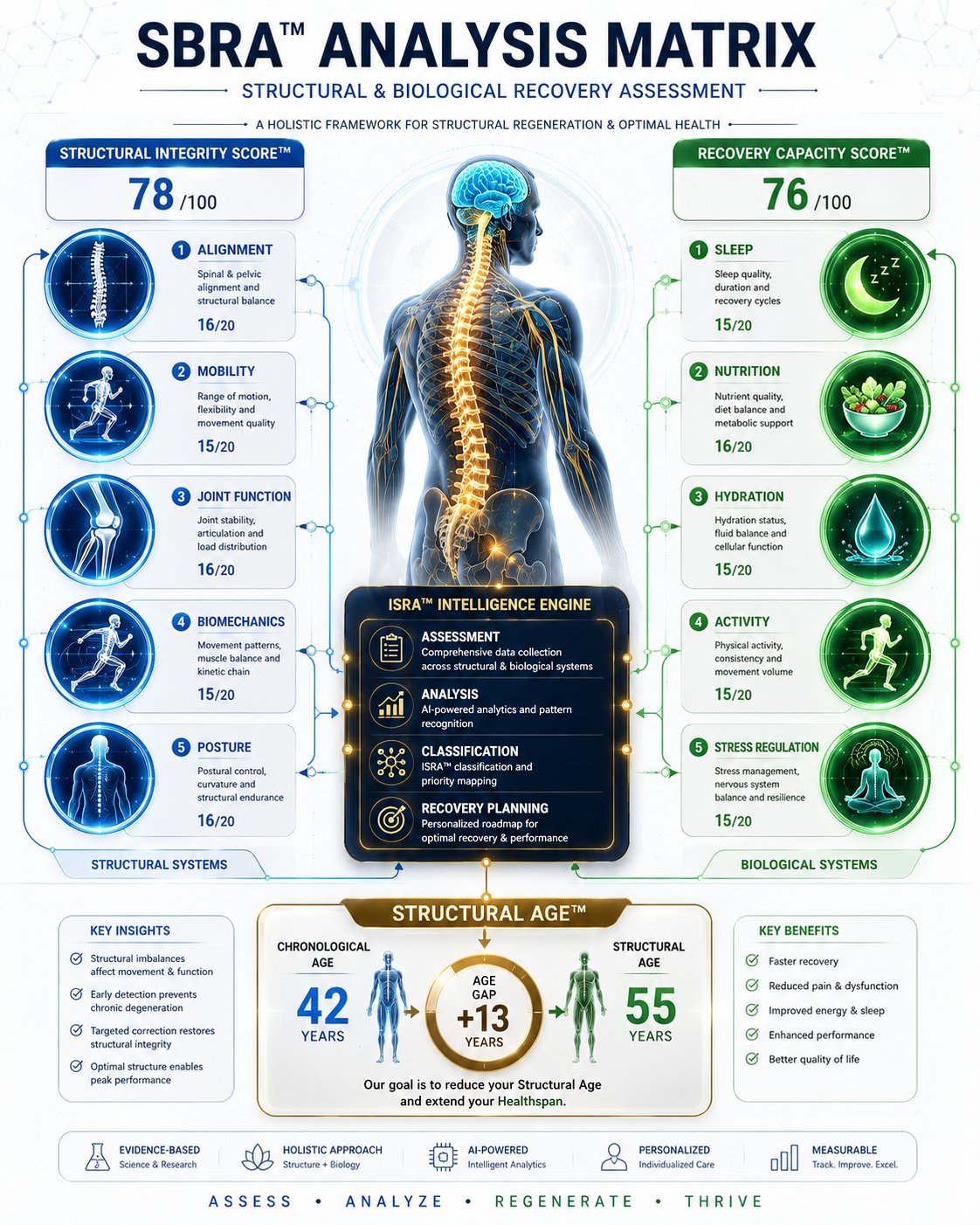
The SBRA Analysis Matrix is the diagram that shows how the assessment becomes a plan. It is a matrix — a grid — where the structural side and the biological side meet in the middle, at the ISRA Intelligence Engine. On the left, the five structural pillars are scored. On the right, five biological factors are scored. At the bottom, Structural Age compares the structure with the person’s actual age. This page explains how the matrix works and how it turns into a plan.
The structural side — scored out of 100
The left side carries the Structural Integrity Score, out of 100, built from the five structural pillars. Each pillar is scored out of 20, and the five scores add up to 100: Alignment (spinal and pelvic alignment, and structural balance); Mobility (range of motion, flexibility, and movement quality); Joint Function (joint stability, articulation, and load distribution); Biomechanics (movement patterns, muscle balance, and the kinetic chain — the way force travels through the body); and Posture (postural control, curvature, and structural endurance). The total is the Structural Integrity Score, in five bands: Exceptional (90–100), Functional (75–89), Compensated (60–74), Significant Dysfunction (40–59), and Collapse Risk (below 40). The score is a starting point, not a verdict, and it is re-measured at follow-up visits.
The biological side — scored out of 100
The right side carries the Recovery Capacity Score, out of 100, built from five everyday factors, each scored out of 20: Sleep (quality, duration, and recovery cycles — sleep is when the body repairs itself); Nutrition (nutrient quality, diet balance, and metabolic support); Hydration (hydration status, fluid balance, and cellular function — the discs and soft tissues depend on hydration); Activity (physical activity, consistency, and movement volume); and Stress Regulation (stress management, nervous system balance, and resilience). The total is the Recovery Capacity Score: the body’s ability to recover, adapt, and perform under stress — not how damaged the structure is, but how much capacity the body has to improve.
How the everyday factors relate to the five biological pillars
The five everyday factors are a patient-facing view of the same biology that SBRA scores through its five biological pillars. Sleep feeds Recovery — the body’s ability to repair and recover between sessions. Nutrition and Hydration feed Tissue Support and Lifestyle — the condition of the soft tissues and the daily habits that shape the body. Activity feeds Lifestyle. Stress Regulation feeds the Nervous System. And Traditional (Unani) — the fifth biological pillar, covering Mizaj (temperament) and the traditional care that supports recovery — is the lens through which the whole biological side is understood. The everyday factors are what the patient can see and change. The pillars are how the practitioner scores and plans. They are two views of the same biology.
The centre — the ISRA Intelligence Engine
Between the two sides is the ISRA Intelligence Engine, with four parts: Assessment (comprehensive data collection across the structural and biological systems); Analysis (finding the patterns — which pillars are struggling, and how they relate); Classification (the ISRA classification, Types A–D, and the priority mapping); and Recovery Planning (a personalised roadmap). The engine is the meeting point of the matrix. The structural scores come in from the left, the biological scores come in from the right, and the engine turns them into a classification and a plan. That is what a matrix is for: not only to measure, but to connect the measurements to action.
Structural Age and the age gap
At the bottom is Structural Age. It compares the person’s chronological age (their actual age) with their structural age (the age their structure most resembles). The difference is the age gap. If the structural age is higher, the structure is carrying more strain than expected for the person’s age. If it is lower, the structure is in better condition than expected. The diagram states the goal plainly: “Our goal is to reduce your Structural Age and extend your Healthspan.” Healthspan means the years of life lived in good health, not only the years lived.
What the matrix is for
The diagram lists four insights: structural imbalances affect movement and function; early detection prevents chronic degeneration; targeted correction restores structural integrity; and optimal structure enables peak performance. These are the reasons the matrix exists: to find the imbalances early, to target the correction, and to measure whether it is working. It also lists five benefits the method aims for: faster recovery, reduced pain and dysfunction, improved energy and sleep, enhanced performance, and better quality of life. These are aims, not guarantees. What the matrix guarantees is not a result, but a method: a plan built on the whole picture, measured as it goes.
What this means for you
For a patient, the matrix is the clearest picture of how your assessment works. Your structure is scored pillar by pillar, out of 20 each. Your biology is scored through factors you can recognise — sleep, food, water, movement, stress. The two sides meet in the middle, and the plan comes out of that meeting. For a practitioner, the matrix turns the assessment into a plan: score the pillars, find the priority, and build the roadmap around it.
Continue learning
To see how the ten pillars are scored, read SBRA — the assessment engine. To understand the method the matrix serves, read What is ISRA?. If you are a patient and would like an assessment, the clinic’s booking page is at matibalmualij.com.