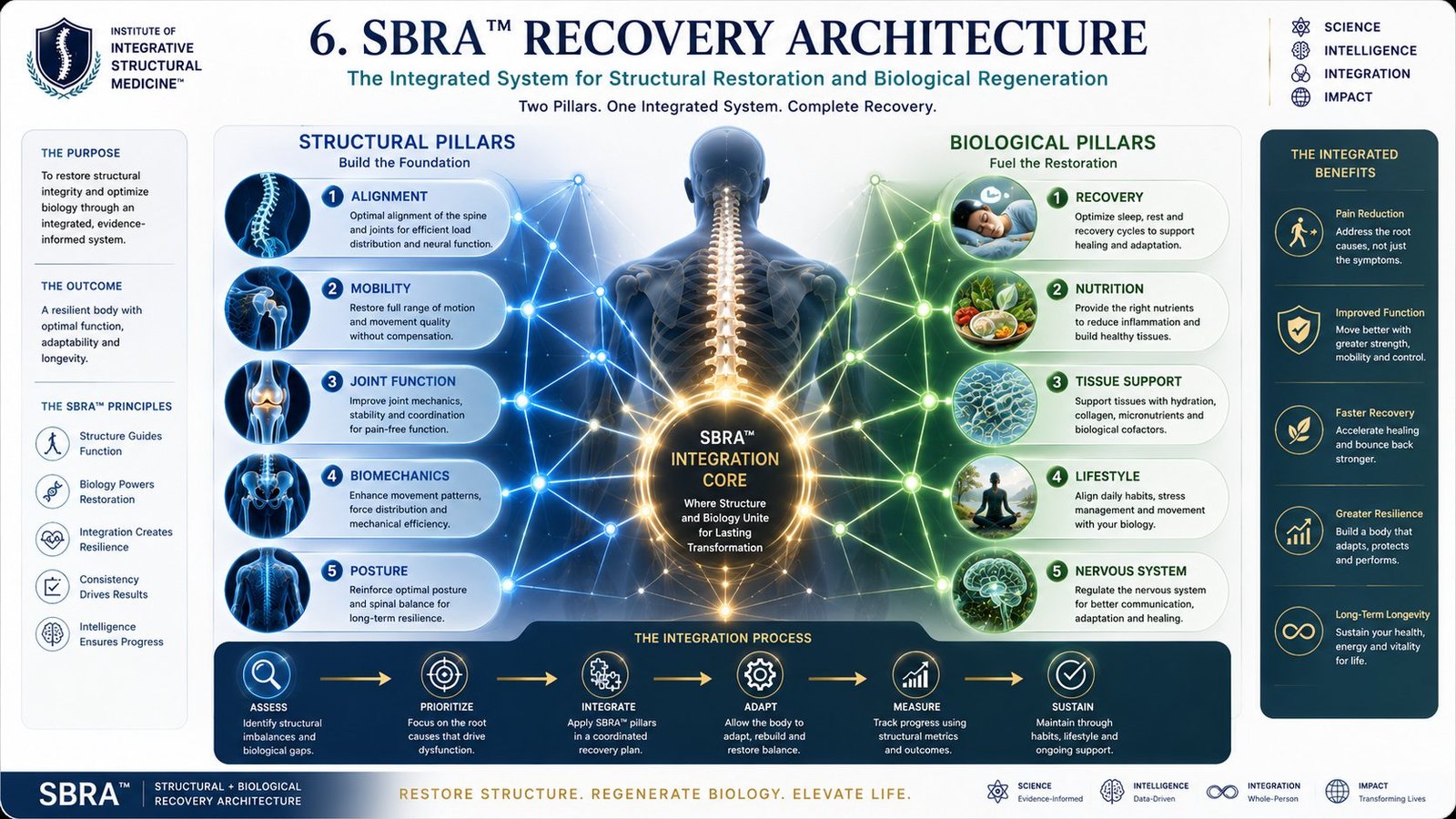
SBRA — Structural & Biological Rehabilitation Architecture — is the integrated system that makes ISRA work. The diagram shows it as two sets of pillars, joined at a core. On one side, five structural pillars build the foundation. On the other, five biological pillars fuel the restoration. Where they meet, in the middle, is the SBRA Integration Core: the place where structure and biology unite. This page explains each pillar, the principles that hold the system together, and the process that turns the pillars into a plan.
The purpose
The diagram states the purpose plainly: to restore structural integrity and optimise biology through an integrated, evidence-informed system. The outcome it aims for is a resilient body with optimal function, adaptability, and longevity. That is the whole point of SBRA — not to treat a single symptom, but to restore the structure and support the biology so that the body can function well and keep functioning.
The five structural pillars — build the foundation
1. Alignment. The optimal alignment of the spine and joints, so that load is distributed efficiently and the nerves function properly. When alignment is off, some parts carry more load than they should. Alignment is the foundation — without it, everything else is compromised.
2. Mobility. Restoring the full range of motion and the quality of movement, without compensation. Stiffness in one place often forces too much movement somewhere else, and the pain usually appears where the extra movement happens.
3. Joint Function. Improving joint mechanics, stability, and coordination, so that each joint does its job properly. A joint that is not working changes the way the whole spine moves, even if the joint itself does not hurt.
4. Biomechanics. Enhancing movement patterns, force distribution, and mechanical efficiency. Good biomechanics spreads the load across the body. Poor biomechanics concentrates it where it hurts — usually the lower back or the neck.
5. Posture. Reinforcing optimal posture and spinal balance for long-term resilience. Posture is the shape the body settles into, hour after hour, and it is one of the biggest loads on the spine.
The five biological pillars — fuel the restoration
1. Recovery. Optimising sleep, rest, and the body’s recovery cycles, so that healing and adaptation can happen between sessions. Recovery is a capacity, not a single event.
2. Lifestyle. Aligning daily habits, stress management, and movement with the body’s needs. This is the load you put on your own body every day — and the part you have the most control over.
3. Traditional (Unani). The Unani side of the picture: your Mizaj, or temperament — the natural constitution of the body — and the traditional care that supports recovery. Unani medicine has always treated the person, not only the disease.
4. Tissue Support. Supporting the soft tissues with hydration, collagen, micronutrients, and the biological factors the tissues need. The muscles, ligaments, and discs hold the spine together. When they are weak or irritated, the spine feels it.
5. Nervous System. Regulating the nervous system for better communication, adaptation, and healing. When a nerve is pressed or irritated, it can cause pain, numbness, or weakness — sometimes far from the spine itself.
The SBRA Integration Core
Between the two sets of pillars is the SBRA Integration Core: “Where Structure and Biology Unite for Lasting Transformation.” This is the key idea of the whole diagram. Structural correction alone — the manual-only approach — addresses the mechanics but neglects the tissue environment, so corrections do not hold. Biological support alone — the Unani-only approach — addresses the internal conditions but cannot correct a mechanical dysfunction, so the root cause persists. Only the integration of both creates the conditions for lasting recovery.
The five principles
The diagram lists five principles. Structure guides function: the condition of the structure decides how well the body can function. Biology powers restoration: the body’s internal conditions decide whether a correction will hold. Integration creates resilience: the combination of structure and biology builds a body able to take load and recover. Consistency drives results: the plan has to be followed steadily. Intelligence ensures progress: the scores are measured and re-measured, so the plan is guided by what is actually happening.
The integration process
Along the bottom is the process that turns the pillars into a plan: Assess (identify the structural imbalances and the biological gaps), Prioritise (focus on the root causes — the most important thing first), Integrate (apply the SBRA pillars in a coordinated recovery plan), Adapt (allow the body to adapt, rebuild, and restore balance), Measure (track progress using the structural metrics and the outcomes), and Sustain (maintain the improvement through habits, lifestyle, and ongoing support). This process sits inside the wider four-phase roadmap of ISRA — Assess, Correct, Support, Maintain — the clinical sequence the plan follows.
What the system aims for
The right side of the diagram lists the integrated benefits: pain reduction, improved function, faster recovery, greater resilience, and long-term longevity. These are what the system is designed to achieve — the aims, not guarantees. Whether a person reaches them depends on the problem, the person, and how the body responds. What can be said is that a plan built on the whole picture — structure and biology together — gives the body the best conditions to recover.
What this means for you
For a patient, SBRA is the reason the assessment looks at ten things instead of one — your spine, sleep, food, temperament, and nerves are one system. For a practitioner, it is the framework that turns an assessment into a plan: score the ten pillars, find the priority, and build around it.
Continue learning
To see how the ten pillars are scored and what the scores mean, read SBRA — the assessment engine. To understand the method built on SBRA, read What is ISRA?. If you are a patient and would like an assessment, the clinic’s booking page is at matibalmualij.com.