
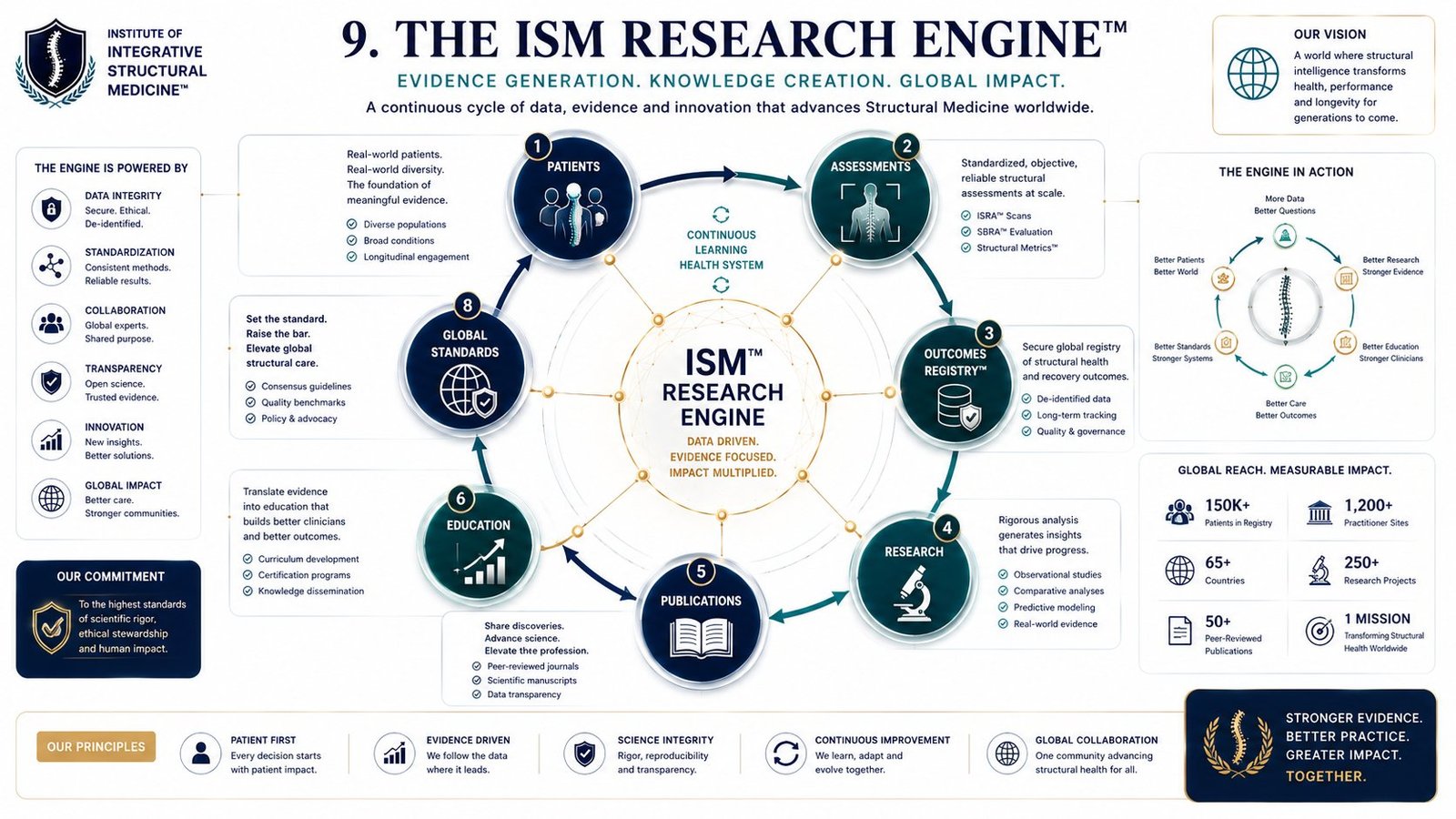
The ISM Research Engine is the part of the academy that learns. It is a continuous cycle: patients are assessed, the results are recorded, the results are studied, the findings are published, the teaching is improved, and the standards are raised — and then the cycle begins again, with better questions. This page explains the cycle, what powers it, and why it matters.
The diagram’s tagline is “Evidence generation. Knowledge creation. Global impact.” And underneath: “A continuous cycle of data, evidence and innovation that advances Structural Medicine worldwide.” The engine does not exist for its own sake. It exists so that the method keeps improving, and so that what is learned from one patient helps the next.
The cycle
The diagram shows the engine as a cycle of stages, each feeding the next.
Patients. The cycle begins with real patients — real people, with real diversity of age, body, work, and condition. The foundation of meaningful evidence is real-world patients, followed over time, not only the easy cases.
Assessments. Patients are assessed using standardised, objective, reliable methods — the ISRA assessment, the SBRA evaluation, and the structural metrics. Standardisation matters: if every patient is assessed the same way, the results can be compared. The nine-stage ISRA assessment and the SBRA scoring are what make the data comparable.
Outcomes Registry. The results are recorded in a secure registry of structural health and recovery outcomes. The registry is de-identified — the data is separated from the names of the patients — and it is tracked over the long term, with quality checks and governance. The registry is one of the eight components of the ISM ecosystem, and it is the memory of the method: everything that has been found, kept in one place, so that it can be studied.
Research. The registry data is studied. Rigorous analysis generates insights that drive progress: observational studies, comparative analyses, predictive modelling, and real-world evidence. Research asks the questions the clinic cannot answer from a single case: which pillars matter most, which plans work best for which types of problem, and what predicts a good recovery.
Publications. The findings are shared — peer-reviewed journals, scientific manuscripts, and open data. Publication matters because it puts the findings where others can check them. A result that is never published cannot be tested, and a method that is never tested cannot be trusted.
Education. The evidence is translated into teaching: curriculum development, certification programmes, and the sharing of knowledge. When research finds something new, the teaching changes. When the teaching changes, the next generation of practitioners learns the improved method.
Global Standards. The findings are turned into standards: consensus guidelines, quality benchmarks, and policy and advocacy. Standards set the bar for the whole field — what good practice looks like — and raise the level for everyone, not only for the academy’s own practitioners.
And then the cycle returns to patients, with better questions, better assessments, and better standards. The diagram calls this a “continuous learning health system.” Each time around the cycle, the method is a little better than it was before.
What powers the engine
The diagram lists six things that power the engine: data integrity (the data is secure, ethical, and de-identified — patient privacy is a condition of the whole system, not an afterthought); standardisation (consistent methods, reliable results); collaboration (global experts, working to a shared purpose — no single clinic can answer the big questions alone); transparency (open science, trusted evidence — the methods and the findings are shared, not hidden); innovation (new insights, better solutions); and global impact (better care, stronger communities).
The principles
The diagram closes with five principles. Patient first: every decision starts with patient impact. The research exists to help patients, not to produce papers. Evidence driven: follow the data where it leads, even when it is inconvenient. Science integrity: rigour, reproducibility, and transparency. A result that cannot be reproduced is not a result. Continuous improvement: learn, adapt, and evolve together. The method is never finished. Global collaboration: one community, advancing structural health for all.
The virtuous circle
On the right of the diagram is a small circle that sums up the whole engine: more data leads to better questions, better questions lead to better research, better research leads to stronger evidence, stronger evidence leads to better education, better education leads to stronger clinicians, stronger clinicians lead to better care, better care leads to better outcomes, better outcomes lead to better patients, better patients lead to a better world, a better world leads to better standards, and better standards lead to stronger systems — which produce more data. The circle has no end. That is the point. The engine does not finish. It keeps turning, and each turn makes the method a little better.
What this means for you
For a patient, the Research Engine is the reason the assessment is standardised and the scores are recorded. Your assessment is not only for your own plan. With your privacy protected, the patterns in your case contribute to the academy’s understanding — and the understanding that helps the next patient. For a practitioner, the engine is the reason the method is taught with evidence and updated over time. You are not learning a fixed routine. You are learning a method that is still being refined, by the data it collects.
One honest note: the registry and the research programme are the academy’s direction of travel. The academy is building this engine — the cycle, the standards, and the teaching that follows from them. This page describes the engine as it is designed to work, not as a completed achievement.
Continue learning
To understand the assessment that feeds the engine, read What is ISRA?. To see how the scores are produced, read SBRA — the assessment engine. If you are a patient and would like an assessment, the clinic’s booking page is at matibalmualij.com.