The Global Structural Intelligence Movement is the widest circle of the ISM ecosystem. It is the vision that structural intelligence — the understanding of how the body’s structure shapes its health — should not belong to one clinic, or one country, but should become a shared standard of care, taught and practised everywhere. This page explains what the movement is, the eight domains through which it spreads, and the commitment that holds it together.
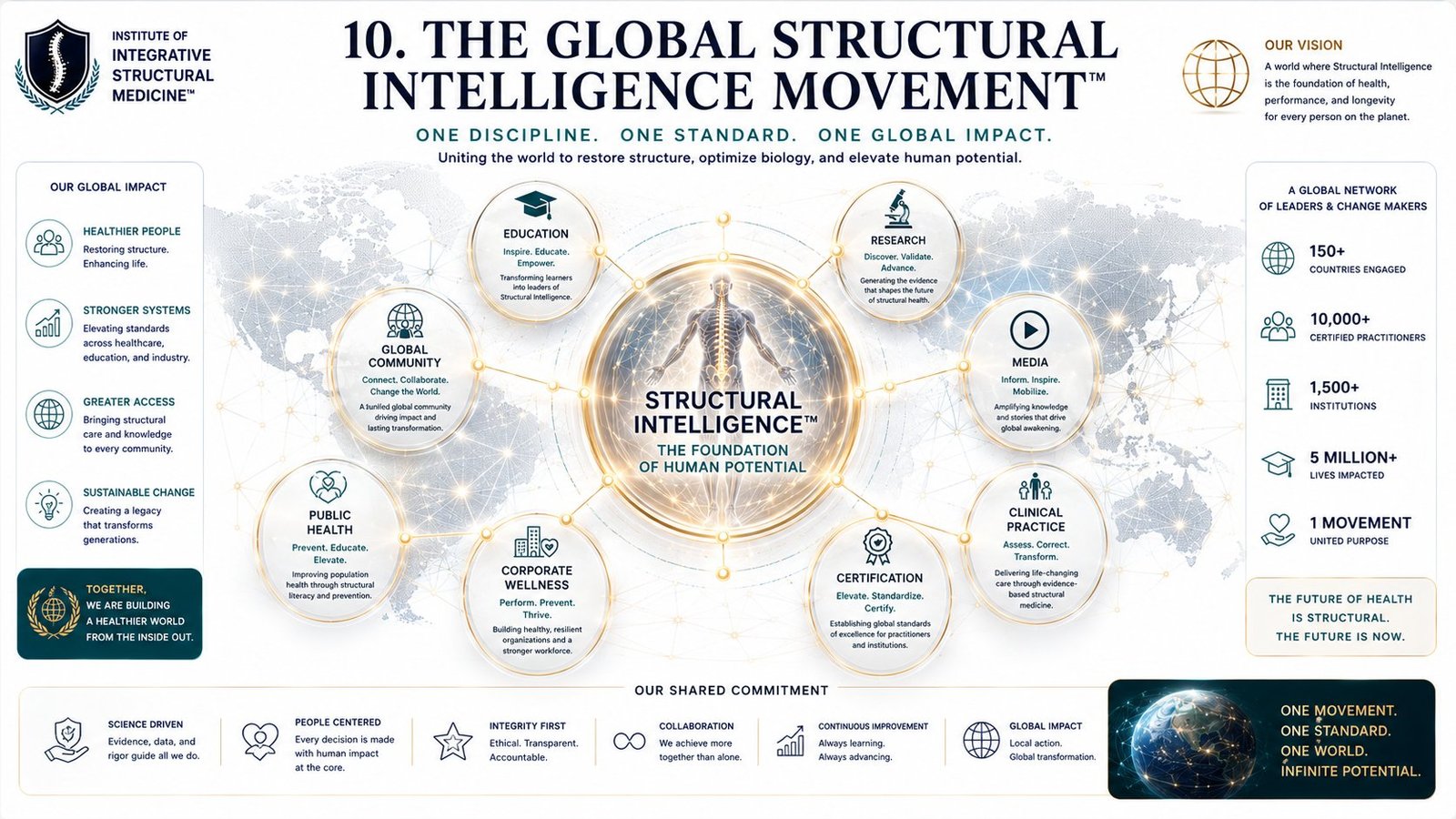
The diagram’s tagline is “One discipline. One standard. One global impact.” And its vision is stated plainly: “A world where Structural Intelligence is the foundation of health, performance, and longevity for every person on the planet.”
That is a vision, not a report of what has already happened. The movement is the direction the academy is working toward. This page describes it as an aspiration and a direction — what the academy is building toward, and how.
The centre: Structural Intelligence
At the centre of the diagram is Structural Intelligence itself, described as “The Foundation of Human Potential.” The idea is that the condition of the body’s structure — how the spine is aligned, how it moves, how it carries load — shapes what the body can do: how well it performs, how long it stays healthy, and how fully a person can live. If that is true, then structural intelligence is not a specialist concern. It is a foundation for health, in the same way that nutrition or exercise is. The movement exists to make that understanding as common as possible.
The eight domains
The diagram shows eight domains around the centre — eight ways in which structural intelligence spreads into the world.
Education — inspire, educate, empower. Transforming learners into leaders of Structural Intelligence. Education is the first domain because the movement begins with teaching: practitioners who learn the method, and the public who learn to understand their own spines. The academy is the education arm of the movement.
Research — discover, validate, advance. Generating the evidence that shapes the future of structural health. Research is how the movement earns its credibility: by studying outcomes, publishing findings, and testing the method openly.
Media — inform, inspire, mobilise. Amplifying knowledge and stories that drive global awareness. Media carries the ideas beyond the clinic and the classroom — articles, videos, and stories that help people understand their own structure.
Clinical Practice — assess, correct, transform. Delivering life-changing care through evidence-based structural medicine. Clinical practice is where the method meets the patient. The Matib Al Mualij clinic is the clinical arm, and the practitioners the academy trains carry the practice outward.
Certification — elevate, standardise, certify. Establishing global standards of excellence for practitioners and institutions. Certification is how the movement keeps its quality: a practitioner who holds the academy’s credential has been trained and assessed to the academy’s standard, wherever they practise.
Corporate Wellness — perform, prevent, thrive. Building healthy, resilient organisations and a stronger workforce. Structural health matters at work — in the office, the factory, and the field — because that is where most spines spend their day.
Public Health — prevent, educate, elevate. Improving population health through structural literacy and prevention. Public health is the widest domain: teaching whole communities to understand their structure, to move well, and to catch problems early, before they become pain.
Global Community — connect, collaborate, change the world. A unified global community driving impact and lasting transformation. No single clinic can change a field alone. A community can.
What the movement aims to change
The left side of the diagram lists four aims. Healthier people — restoring structure, enhancing life. The aim is not only less pain, but better function and a fuller life. Stronger systems — elevating standards across healthcare, education, and industry. Greater access — bringing structural care and knowledge to every community, so that where you live does not decide whether you can get a proper assessment. Sustainable change — creating a legacy that transforms generations.
The shared commitment
The bottom of the diagram lists six commitments the movement holds itself to: science driven (evidence, data, and rigour guide all we do); people centered (every decision is made with human impact at the core); integrity first (ethical, transparent, accountable); collaboration (we achieve more together than alone); continuous improvement (always learning, always advancing); and global impact (local action, global transformation). These are the standards the movement sets for itself — the reason the academy teaches with evidence, measures its outcomes, and publishes its findings.
What this means for you
For a patient, the movement is the reason the clinic’s method is taught, measured, and shared rather than kept private. For a practitioner, the movement is an invitation: to learn the method, to be certified in it, and to join a community that is building a shared standard of structural care.
The movement is young. The academy is its beginning — the first courses, the first practitioners, the first standards. What it becomes depends on the practitioners who join it, and on whether the method proves itself, patient by patient, in the open.
Continue learning
To learn the method the movement is built on, start with What is ISRA?. To see how practitioners are trained, read Practitioner Pathway. To begin, the first course is Ilaj Bil Yad Foundations — free for the pilot cohort, enrolment by invitation only. If you are a patient and would like an assessment, the clinic’s booking page is at matibalmualij.com.