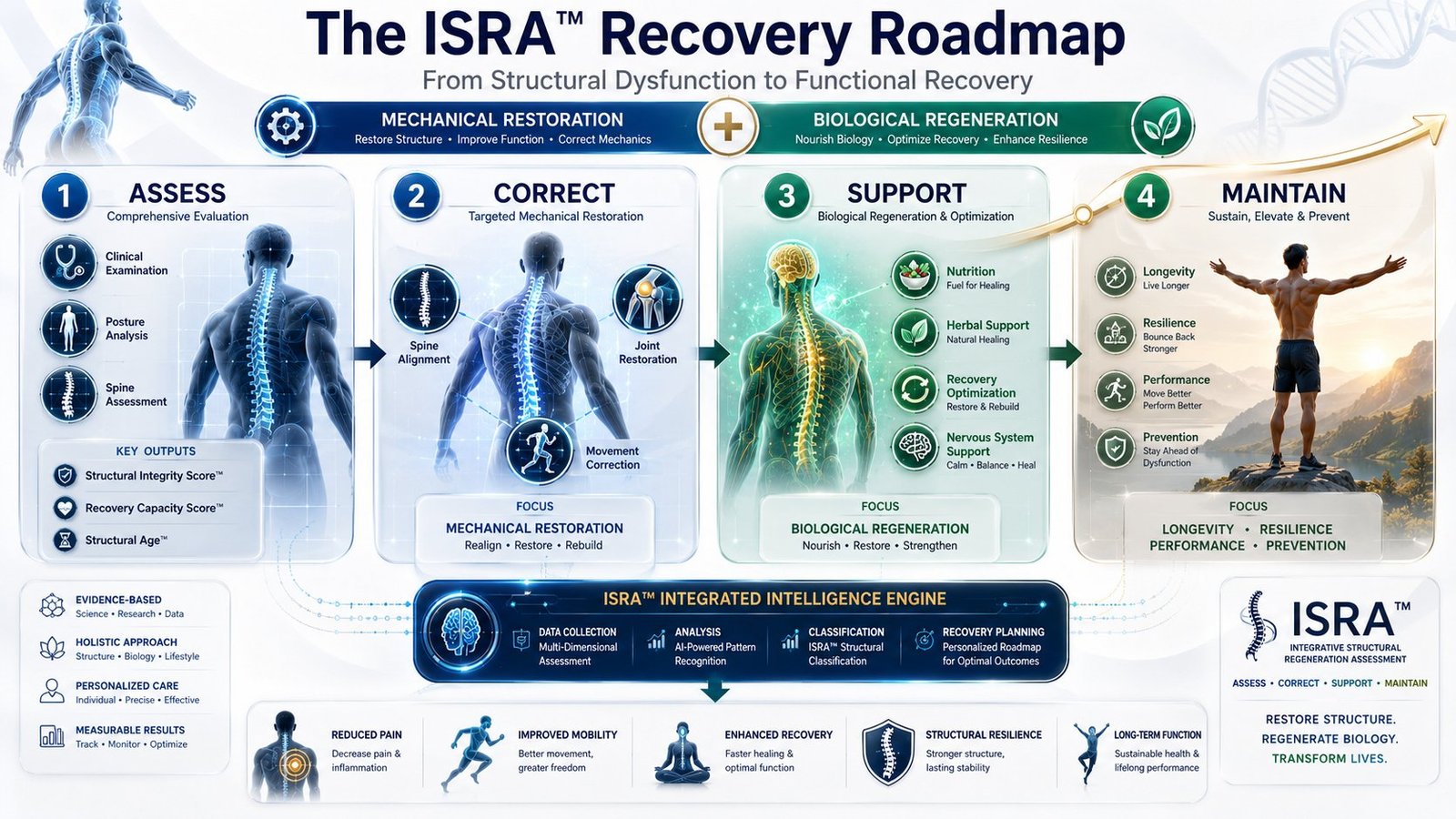
The ISRA Recovery Roadmap is the plan that follows the assessment. It has four phases — Assess, Correct, Support, Maintain — always in that order. This page explains each phase, what happens in it, and how the two tracks of the roadmap (mechanical restoration and biological regeneration) work together.
The diagram’s subtitle is “From Structural Dysfunction to Functional Recovery.” That is the whole journey in one line: the roadmap takes a person from a structure that is not working properly to a body that functions well again.
Two tracks, one roadmap
Across the top are the two tracks that run through the whole roadmap. Mechanical Restoration — restore structure, improve function, correct mechanics. This is the structural side: putting the spine and joints back into proper working order. Biological Regeneration — nourish biology, optimise recovery, enhance resilience. This is the biological side: giving the body what it needs to heal and to hold the correction. Neither works alone. Mechanical restoration without biological support produces corrections that do not hold. Biological support without mechanical restoration cannot fix a structure that is out of alignment. The roadmap runs both tracks together.
Phase 1 — Assess: comprehensive evaluation
The first phase is the assessment itself: the nine-stage ISRA assessment — intake, lifestyle, Unani constitutional assessment, clinical exam, imaging, SBRA analysis, classification, and the findings that become the roadmap. The diagram shows the assessment in three parts: clinical examination, posture analysis, and spine assessment. The key outputs are the three headline numbers — the Structural Integrity Score, the Recovery Capacity Score, and the Structural Age. These are the baseline. Nothing is treated in this phase. The whole point of Assess is to understand the problem properly before doing anything about it. The Urdu principle on the clinic wall says it plainly: معائنہ پہلے، علاج بعد میں — “Assessment first, treatment after.”
Phase 2 — Correct: targeted mechanical restoration
The second phase is the correction work: targeted mechanical restoration, the hands-on work of putting the structure back into proper working order. The diagram shows three elements: spine alignment (restoring the alignment of the spine, so load is distributed properly and the nerves are not compressed); joint restoration (restoring the function of the joints, so each joint moves as it should); and movement correction (correcting the patterns of movement, so the body stops loading the same structures in the same harmful way). The focus is mechanical restoration: realign, restore, rebuild. The main tool is Ilaj Bil Yad — treatment by hand — the Unani manual tradition that ISRA uses as its structural correction protocol. Ilaj Bil Yad has four phases of its own: Tashkhees (diagnosis, which gates everything — no correction without a complete diagnosis), Tayyari (preparation), Taqweem (adjustment), and Taqwiyat (post-care). The correction work is diagnosis-gated: it only begins when the assessment is complete.
Phase 3 — Support: biological regeneration and optimisation
The third phase is the support work: biological regeneration, the care that helps the correction hold and the body recover. The diagram shows four elements: nutrition (fuel for healing — the food the body is given shapes how well its tissues can repair); herbal support (natural healing — Unani herbal medicine, chosen for the person and the problem); recovery optimisation (restore and rebuild — the conditions for recovery: sleep, rest, and the rhythm of repair); and nervous system support (calm, balance, heal — care for the nervous system, so it can regulate the body rather than staying in a state of alarm). The focus is biological regeneration: nourish, restore, strengthen. This phase maps to the five biological pillars of SBRA — Recovery, Lifestyle, Traditional (Unani), Tissue Support, and the Nervous System. A spine that has been corrected but not supported will drift back to where it was.
Phase 4 — Maintain: sustain, elevate, and prevent
The fourth phase is maintenance: the long-term work of keeping the improvement and building on it. The diagram shows four elements: longevity (live longer — keeping the structure healthy over the years); resilience (bounce back stronger); performance (move better, perform better); and prevention (stay ahead of dysfunction — catching problems early, before they become pain again). The focus is longevity, resilience, performance, and prevention. Maintain is not the end of treatment. It is the new way of living: the habits, the movement, and the periodic check-ins that keep the structure in good condition. The roadmap does not end when the pain goes away. It ends when the person has the habits and the understanding to keep themselves well.
The engine underneath
Along the bottom is the ISRA Integrated Intelligence Engine: data collection (a multi-dimensional assessment), analysis (finding the patterns), classification (the Types A–D, and the priority mapping), and recovery planning (a personalised roadmap). The engine is what turns the assessment into the roadmap, and what keeps the roadmap honest — because the scores are re-measured at follow-up, and the plan is adjusted as the person improves.
What the roadmap aims for
The bottom of the diagram lists what the roadmap aims for: reduced pain, improved mobility, enhanced recovery, structural resilience, and long-term function. These are the aims, not guarantees. Whether a person reaches them depends on the problem, the person, and how the body responds. What can be said is that a roadmap built on a thorough assessment, running both tracks together, gives the body the best conditions to recover — and that the scores, measured as you go, will show whether it is working.
What this means for you
For a patient, the roadmap is what happens after the assessment: you will know which phase you are in, and what comes next. For a practitioner, it is the structure of the plan: assess first, correct what the assessment shows, support the biology, and maintain the result.
Continue learning
To understand the assessment that starts the roadmap, read What is ISRA?. To see how the scores that guide the roadmap are produced, read SBRA — the assessment engine. If you are a patient and would like an assessment, the clinic’s booking page is at matibalmualij.com.