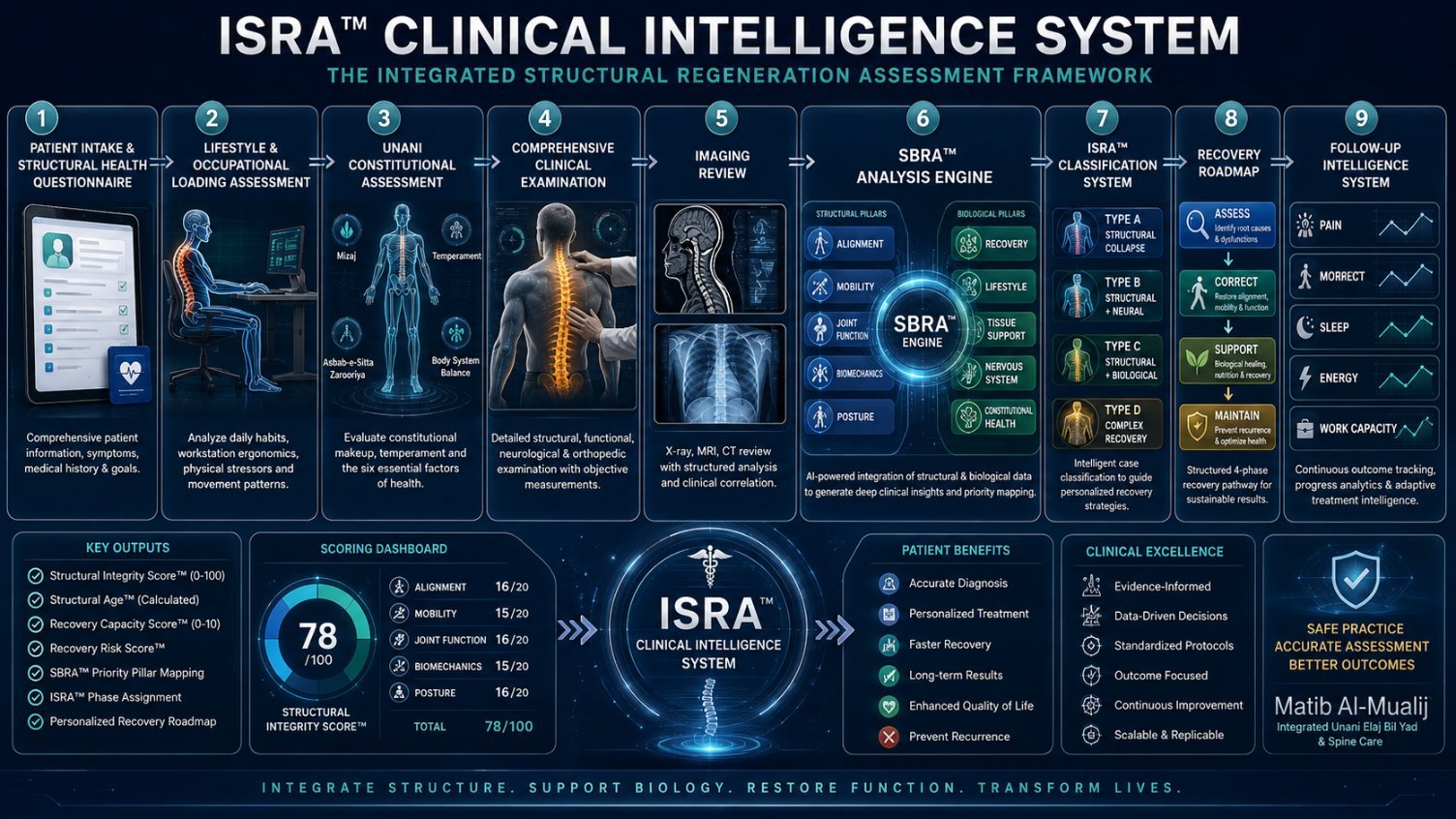
The ISRA Clinical Intelligence System is the full assessment framework, laid out as nine stages in a single diagram. It is the most detailed view of the method the academy teaches: every stage, from the first questionnaire to the follow-up tracking, in order. This page walks through the nine stages, the classification system, and the outputs the framework produces.
The nine stages
1. Patient intake and structural health questionnaire. The process begins with the patient: a comprehensive questionnaire covering personal information, symptoms, medical history, and goals. You are the expert on your own pain, and the assessment begins with your story.
2. Lifestyle and occupational loading assessment. How you live and work: daily habits, workstation ergonomics, physical stressors, and movement patterns. The hours you sit, the way you lift, the posture you hold at work — all of it is load on your spine. This stage finds the daily habits feeding the problem, so the plan can change them.
3. Unani constitutional assessment. The Unani part of the assessment. The practitioner evaluates your constitutional makeup: your Mizaj, or temperament — the natural balance of hot and cold, wet and dry that shapes how your body responds to food, weather, work, and illness — and the Asbab-e-Sitta Zaroriya, the six essential factors of health in Unani medicine. Together with the balance of the body systems, these show the person behind the problem.
4. Comprehensive clinical examination. The practitioner examines you by hand: a detailed structural, functional, neurological, and orthopedic examination, with objective measurements. You will be asked to stand, bend, walk, and turn. The practitioner feels where the movement is free and where it is restricted, which structures are tender, and which muscles are tight. This is often where a trained hand finds what a scan cannot show.
5. Imaging review. If you have X-ray, MRI, or CT reports, they are reviewed here — with structured analysis and clinical correlation. The scan is read alongside the examination findings, not on its own. A scan shows structure. It does not show pain, and it does not show how you live. That is why imaging comes at stage five, not stage one.
6. SBRA analysis engine. The SBRA engine — Structural & Biological Rehabilitation Architecture — scores what has been found. The five structural pillars (Alignment, Mobility, Joint Function, Biomechanics, Posture) and the five biological pillars (Recovery, Lifestyle, Traditional (Unani), Tissue Support, Nervous System) are each scored, and the scores are combined into the outputs: the Structural Integrity Score, the Structural Age, the Recovery Capacity Score, the Recovery Risk Score, and the Priority Pillar Mapping.
7. ISRA classification system. The case is classified into one of four types, so the plan fits the kind of problem that was found. Type A — Structural Collapse: the problem is primarily structural. Type B — Structural + Neural: the problem is structural with nerve involvement, causing pain, numbness, or weakness. Type C — Structural + Biological: the problem is structural with a biological component, and the body’s internal conditions are also struggling. Type D — Complex Recovery: several factors at once, requiring a longer and more carefully sequenced plan. Classification is not a label on a person. It is a way of making sure the treatment matches the problem.
8. Recovery roadmap. The findings become a roadmap in four phases: Assess, Correct, Support, Maintain. Assess is the assessment you have just been through. Correct is the correction work — including Ilaj Bil Yad, hands-on structural correction, where the assessment shows it is needed. Support is the care that supports recovery — diet, regimen, herbal medicine, and the exercises that hold the correction. Maintain is the long-term habits that keep the improvement.
9. Follow-up intelligence system. The last stage is not really a last stage at all. It is what happens at every visit after the first. Progress is tracked continuously — pain, mobility, sleep, energy, and work capacity — each followed over time, so the practitioner and the patient can see what is improving and what is not. The plan adjusts as you improve. The assessment is not a one-time event. It is a running record, and it is what keeps the treatment honest.
The key outputs
The framework produces seven outputs: Structural Integrity Score (0–100) — the headline number, in five bands from Exceptional to Collapse Risk; Structural Age (calculated) — the condition of the structure expressed in years, compared with the person’s actual age; Recovery Capacity Score — the body’s capacity to recover, adapt, and improve; Recovery Risk Score — what could slow recovery down or complicate it; SBRA Priority Pillar Mapping — the map that turns scores into a plan, showing which pillar needs attention first; ISRA Phase Assignment — which phase of the roadmap the patient is in, and what comes next; and a Personalised Recovery Roadmap — the plan itself, built for the individual.
How the scoring works
Each structural pillar is scored out of 20, and the five pillar scores add up to the Structural Integrity Score out of 100. This is how the headline number is built — not from a single impression, but from five separate scores, each measuring one part of the structure. The same approach is used on the biological side. The scores are re-measured at follow-up, so the change in each pillar can be seen, not only the change in the total.
What this means for you
For a patient, this diagram is the full picture of what happens when you come to the clinic: nine stages, in order, none skipped, ending in a plan that is measured as it goes. For a practitioner, it is the framework you will learn to apply.
Continue learning
To read the nine stages in plain words, from the patient’s point of view, read What is ISRA?. To see how the SBRA scoring works, read SBRA — the assessment engine. If you are a patient and would like an assessment, the clinic’s booking page is at matibalmualij.com.