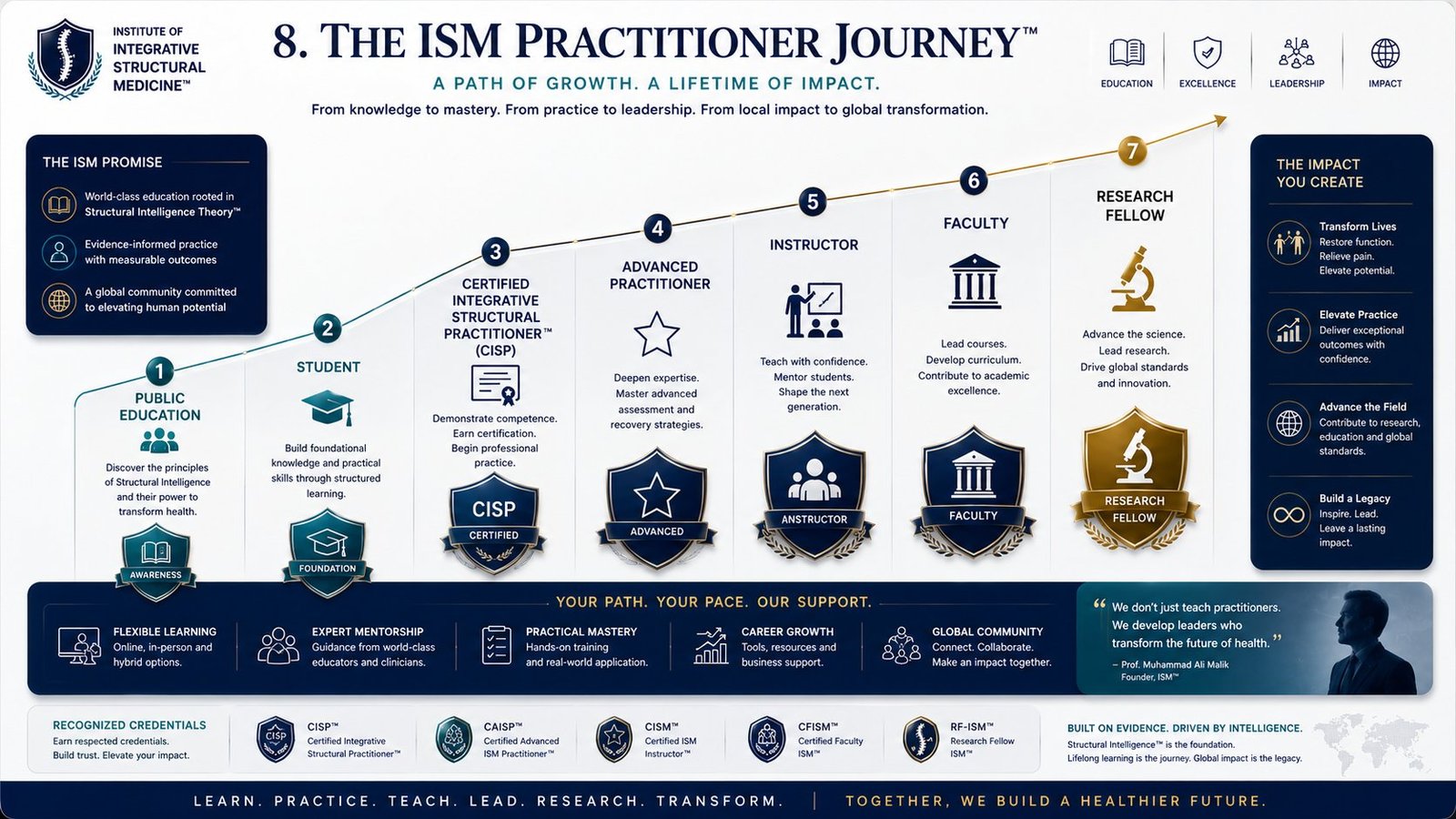
The ISM Practitioner Journey is the path a practitioner follows through the academy, from the first time they encounter the method to the point where they are helping to build it. The diagram shows seven steps, rising from open learning for everyone to research. This page explains each step, what it requires, and what it is for.
The diagram’s tagline is “A path of growth. A lifetime of impact.” And underneath: “From knowledge to mastery. From practice to leadership. From local impact to global transformation.” That is the shape of the journey: it begins with learning, it deepens into practice, and it ends — for those who go the whole way — in teaching and research.
The seven steps
1. Public Education — open learning for everyone. This is where everyone starts, and it is open to all. The academy’s public learning is for anyone who wants to understand their spine and their health better: patients, families, students, and the simply curious. There is no enrolment, no exam, and no certificate at this step. The academy’s free public course, “Your Spine, Explained,” is coming soon for this step.
2. Student — enrolled on a course. The second step is to enrol on a course. As a student you study the method properly, lesson by lesson, with assessments that check your understanding as you go. The first course is Ilaj Bil Yad Foundations, and it is where every practitioner begins.
3. CISP — Certified ISM Structural Practitioner. CISP is the academy’s first professional credential, and it is earned, not given. To become a CISP you must complete Course 1 — Ilaj Bil Yad Foundations — including its final quiz, its graded case assignment, and the in-person practical at the clinic. A CISP is a practitioner who has been assessed in the method and can practise it to the academy’s standard. The requirements are: complete Course 1 (8 Urdu video lessons); pass the final quiz (80% to pass); complete the graded case assignment (an 800–1,200-word four-phase plan for a teaching case); and complete the in-person practical at the clinic, where your hands-on work is assessed in person. The in-person practical is required for the certificate. There is no shortcut around the hands-on part: this is a hands-on method, and it can only be assessed hands-on. One honest note: the CISP certificate is the academy’s own credential. It is not a government-recognised qualification. It certifies that you have been trained and assessed in the academy’s method, to the academy’s standard.
4. Advanced — deepening the work. After CISP comes Advanced. This is the level where a certified practitioner deepens their assessment and correction skills, building on the foundation of Course 1. It is the step between being certified and being ready to teach others, and it is where a practitioner’s understanding of ISRA becomes thorough rather than introductory.
5. Instructor — teaching under supervision. An Instructor is a practitioner who has begun to teach, under the supervision of the academy’s faculty. Teaching is part of learning: explaining the method to others is how a practitioner proves they truly understand it. Instructors teach with guidance and feedback, not alone. They mentor students and help shape the next generation.
6. Faculty — leading courses. Faculty are the practitioners who lead courses themselves. They carry the teaching of the academy, set its standard in the classroom, develop curriculum, and guide the instructors beneath them. Reaching faculty means the academy trusts you to teach its method in your own name.
7. Research Fellow — contributing to the academy’s research. The final step is Research Fellow. A Research Fellow contributes to the academy’s research — studying outcomes, refining the method, and adding to what the academy knows. This is the step where a practitioner stops only practising the method and starts helping to build it.
The ISM Promise
The diagram states the academy’s promise in three lines: world-class education rooted in Structural Intelligence Theory; evidence-informed practice with measurable outcomes; and a global community committed to elevating human potential. That is what the academy offers at every step: teaching grounded in the theory, practice guided by measurement, and a community of practitioners working to the same standard.
The support along the way
The diagram lists five kinds of support the academy provides: flexible learning (online, in-person, and hybrid options, so learning fits around practice); expert mentorship (guidance from educators and clinicians who have walked the path themselves); practical mastery (hands-on training and real-world application, not only theory); career growth (tools, resources, and business support for building a practice); and global community (a network of practitioners to connect with, collaborate with, and learn from). No one climbs the ladder alone. Each step has teaching, mentoring, and a community behind it.
The impact a practitioner creates
The diagram closes with what the journey is for: transforming lives, elevating practice, advancing the field, and building a legacy. A practitioner who completes the journey does not only treat patients. They restore function and relieve pain. They deliver outcomes with confidence. They contribute to research, education, and global standards. As Prof. Muhammad Ali Malik puts it on the diagram: “We don’t just teach practitioners. We develop leaders who transform the future of health.”
You do not have to climb the whole ladder
The steps are in order, and each one builds on the one before it. But you do not have to climb the whole ladder. Many people stop at the step that fits their work. A practitioner who reaches CISP and practises well has already achieved something real. The further steps are there for those who want to teach, to lead, and to research. The journey is yours, at your pace, with the academy’s support.
Continue learning
For the step-by-step pathway in plain words, read Practitioner Pathway. To begin, the first course is Ilaj Bil Yad Foundations — free for the pilot cohort, enrolment by invitation only. If you are a patient and would like an assessment, the clinic’s booking page is at matibalmualij.com.