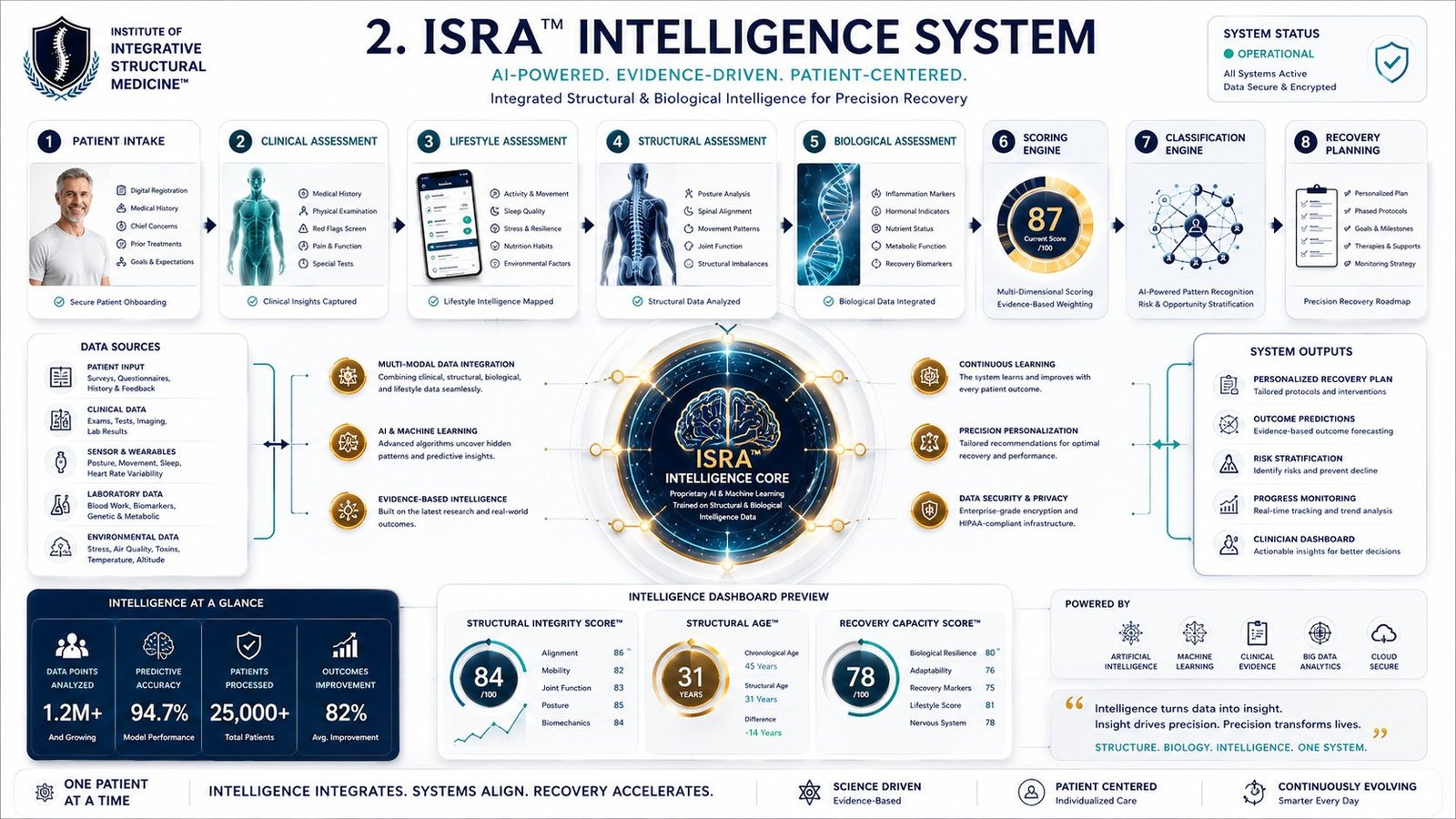
ISRA — Integrated Structural Rehabilitation Architecture — is a method for understanding a spine or movement problem properly before treating it. The diagram on this page shows ISRA as an intelligence system: a way of gathering information about a person, making sense of it, and turning it into a plan. This page explains what the diagram shows.
The idea in one sentence
Information in, understanding out, plan follows. The system takes everything the assessment finds — what you say, what the examination shows, what your reports say, and how you live — and brings it together in one place, so the plan is built on the whole picture rather than on a single finding.
The eight steps in the diagram
The top of the diagram shows the system’s flow in eight steps, from the first conversation to the finished plan.
1. Patient intake. The process begins with you: your history, your pain, your previous treatments, and what you hope to achieve. You are listened to before anything is examined or measured.
2. Clinical assessment. The practitioner examines you — your medical history, a physical examination, a screen for red flags (the warning signs that need urgent attention), and tests of pain and function.
3. Lifestyle assessment. How you live: your activity and movement, your sleep, your stress, your food, and the environment you live and work in. A spine problem is rarely only about the spine, and the system records your daily life alongside the clinical findings.
4. Structural assessment. The spine itself: posture, alignment, movement patterns, joint function, and any structural imbalances. The mechanical side — how the structure is built and how it moves.
5. Biological assessment. The person the spine belongs to: the markers of inflammation, the hormones, the nutrition, the metabolism, and the body’s capacity to recover. The internal conditions that decide whether a correction will hold.
6. Scoring engine. The findings are scored. This is the SBRA engine — Structural & Biological Rehabilitation Architecture — which turns what has been found into numbers: a Structural Integrity Score out of 100, a Structural Age, a Recovery Capacity Score, and more. A score can be measured again at the next visit, and the two numbers compared.
7. Classification engine. The case is classified into one of four types, A to D, so the plan fits the kind of problem that was found. Classification is the bridge between measuring and treating.
8. Recovery planning. The last step is the plan itself: a personalised plan, with phased protocols, goals and milestones, and a way of monitoring progress.
What feeds the system
The left side of the diagram shows where the information comes from. There are five sources: patient input (what you tell us — surveys, questionnaires, your history, and your feedback); clinical data (the physical examination, the imaging, and the laboratory results); sensors and wearables (measurements of movement, posture, sleep, and heart rate, where they are used); laboratory data (blood work, biomarkers, and metabolic information, where relevant); and environmental data (stress, air quality, temperature, and altitude). These sources are combined — clinical, structural, biological, and lifestyle information brought together — so that no single source decides the plan on its own.
What the system produces
The right side of the diagram shows the five outputs: a personalised recovery plan (protocols and interventions tailored to the person); outcome predictions (an evidence-based forecast of what recovery may look like, so expectations are honest from the start); risk stratification (identifying what could slow recovery down, so the plan can account for it in advance); progress monitoring (tracking how the scores change over time, so the plan can be adjusted as you improve); and a clinician dashboard (the information presented clearly to the practitioner, so decisions are based on the whole picture).
How this relates to the nine-stage assessment
If you have read the academy’s page on ISRA, you will have seen the nine-stage clinical assessment: intake, lifestyle, Unani constitutional assessment, clinical exam, imaging, SBRA analysis, classification, the four-phase roadmap, and follow-up. The diagram on this page shows the same work from the system’s point of view — how information flows and where it is scored and classified. The clinical assessment is what happens to you as a patient; the intelligence system is how the information from that assessment is organised and used. They are two views of the same method, not two different methods.
What this means for you
For a patient, the point of the system is simple: nothing about you is treated in isolation. Your pain, your spine, your sleep, your food, and your daily life are all part of one picture, and the plan is built from that picture. For a practitioner, the point is that the assessment produces numbers that can be followed — so you can see, visit by visit, whether the plan is working, and change it if it is not.
Continue learning
To understand the method itself, start with What is ISRA?. To see how the scoring works, read SBRA — the assessment engine. If you are a patient and would like an assessment, the clinic’s booking page is at matibalmualij.com.