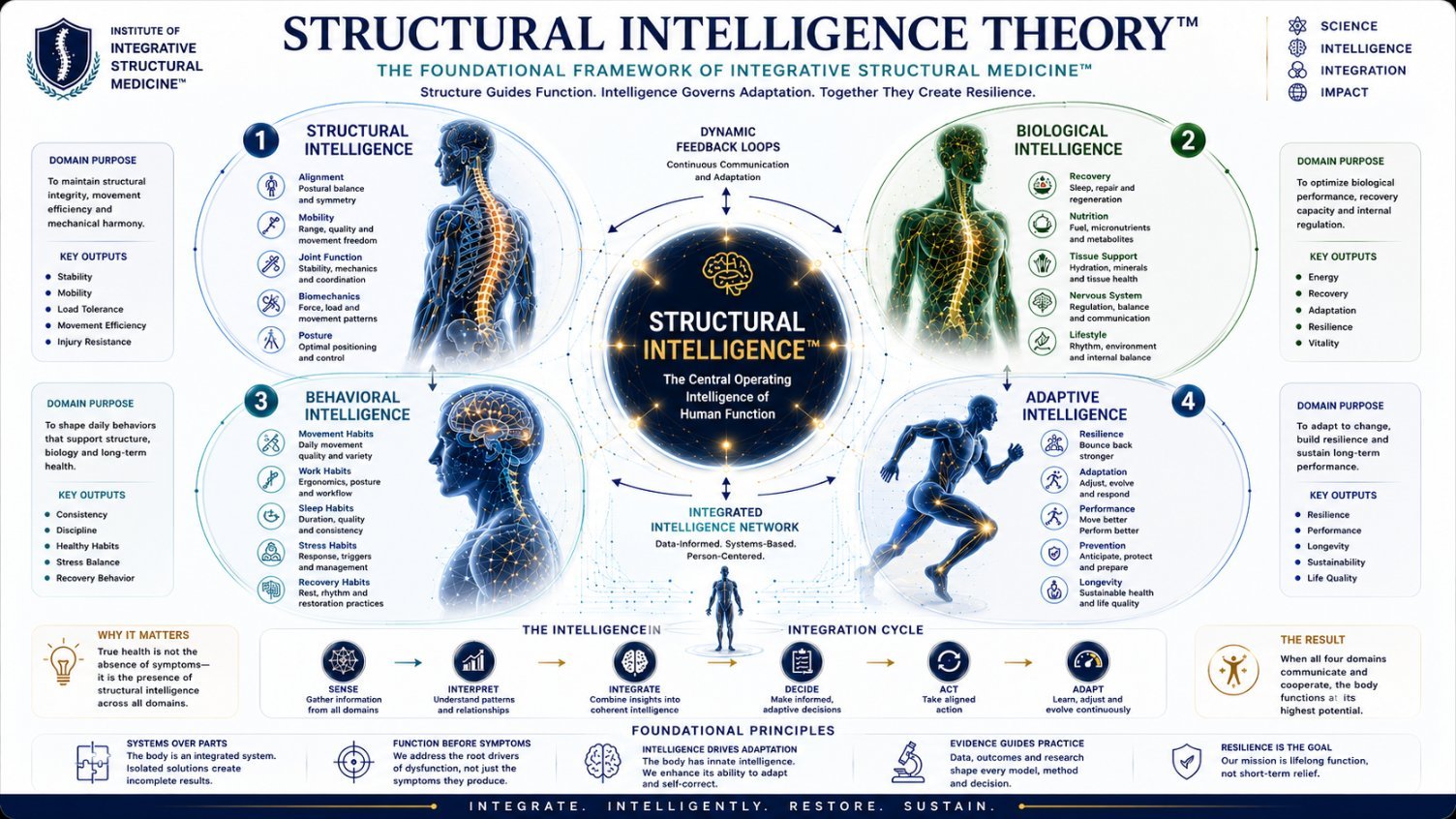
Structural Intelligence Theory is the foundational idea behind everything the ISM Academy teaches: the spine — and the body around it — is not a collection of separate parts, but an integrated system, and health depends on how well that system works together. This page explains the diagram: the four domains of intelligence, how they connect, and the cycle that keeps them working.
The central idea
The diagram puts one phrase at its centre: “Structure guides function. Intelligence governs adaptation. Together they create resilience.” In plain words: the shape and condition of your structure decide how well your body can function. Your body’s ability to adapt — to respond to load, to recover, to change — is governed by intelligence, the body’s own capacity to sense what is happening and adjust. When structure is sound and adaptation works, the result is resilience: the ability to take load, recover, and keep going.
The four domains
1. Structural Intelligence — the structure itself. The domain of the spine and the musculoskeletal system. Its five elements are the five structural pillars of SBRA: Alignment (how the spine and joints sit, and whether posture is balanced), Mobility (the range, quality, and freedom of movement), Joint Function (the stability, mechanics, and coordination of each joint), Biomechanics (the forces and load on the body, and the patterns of movement), and Posture (the optimal positioning and control of the body). Its purpose is to maintain structural integrity, movement efficiency, and mechanical harmony. Its outputs are stability, mobility, load tolerance, movement efficiency, and resistance to injury.
2. Biological Intelligence — the body that supports the structure. The domain of the body’s internal conditions. Its five elements are the five biological pillars of SBRA: Recovery (sleep, repair, and regeneration), Lifestyle (the daily habits, rhythm, and environment that shape the body’s condition), Traditional (Unani) (your Mizaj, or temperament, and the traditional care that supports recovery), Tissue Support (hydration, minerals, and tissue health), and Nervous System (regulation, balance, and communication). Its purpose is to optimise biological performance, recovery capacity, and internal regulation. Its outputs are energy, recovery, adaptation, resilience, and vitality. When this domain is working, the body has the resources to repair itself and to hold a correction.
3. Behavioral Intelligence — the daily habits. The domain of what you do every day: Movement Habits (the quality and variety of daily movement), Work Habits (ergonomics, posture, and the demands of the working day), Sleep Habits (duration, quality, and consistency), Stress Habits (how you respond to stress, and how you manage it), and Recovery Habits (rest, rhythm, and the practices that restore the body). Its purpose is to shape the daily behaviours that support structure, biology, and long-term health. This is the domain you have the most control over, and it is often the one that decides whether a correction holds once you go home.
4. Adaptive Intelligence — the ability to change. The domain of how the body responds to change over time: Resilience (bounce back, stronger), Adaptation (adjust, evolve, and respond), Performance (move better, perform better), Prevention (anticipate, protect, and prepare), and Longevity (sustainable health and quality of life). Its purpose is to adapt to change, build resilience, and sustain long-term performance. This is the domain that turns a short-term improvement into a lasting one.
How the four domains connect
The four domains do not work separately. The diagram shows them connected by dynamic feedback loops — continuous communication and adaptation between them. Poor sleep (behavioral) weakens recovery (biological), which leaves the tissues less able to support the spine (structural), which reduces the body’s ability to adapt (adaptive). The reverse is also true: improving one domain supports the others. That is why the method looks at the whole person, not only the painful part. At the centre is Structural Intelligence itself — the central operating intelligence of human function — and beneath it, the Integrated Intelligence Network: data-informed, systems-based, and person-centered.
The integration cycle
Along the bottom is a six-step cycle: Sense (gather information from all domains), Interpret (understand the patterns and relationships), Integrate (combine the insights into a coherent picture), Decide (make informed, adaptive decisions), Act (take aligned action), and Adapt (learn, adjust, and evolve continuously). Then the cycle begins again. It is not a straight line from problem to solution. It is a loop — and that is how the plan stays honest, because it is checked and adjusted as the person changes.
The foundational principles
The diagram closes with five principles. Systems over parts: the body is an integrated system, and isolated solutions create incomplete results. Function before symptoms: address the root drivers of dysfunction, not just the symptoms they produce. Pain is a signal; the cause is usually elsewhere. Intelligence drives adaptation: the body has an innate intelligence, and the method works with its ability to adapt and self-correct. Evidence guides practice: data, outcomes, and research shape every model, method, and decision. Resilience is the goal: the mission is lifelong function, not short-term relief.
What this means for you
For a patient, the theory explains why the assessment looks at so much more than the painful spot. Your spine, your sleep, your food, your work, and your stress are four domains of one system, and the assessment has to see all four before it can build a plan. For a practitioner, the theory is the reason the method is systematic: sense, interpret, integrate, decide, act, adapt — and then begin again.
Continue learning
To see how the structure and biology are scored, read SBRA — the assessment engine. To understand the method built on this theory, read What is ISRA?. If you are a patient and would like an assessment, the clinic’s booking page is at matibalmualij.com.